



Vanonpower.com – To convert inverter power in watts to current in amps, divide the total wattage by the voltage of your battery bank, then account for an efficiency factor and a safety margin to ensure your system does not overload.
Understanding the relationship between watts and amps is the cornerstone of designing a reliable off-grid power system. Many beginners make the mistake of looking only at the inverter’s output capacity without considering the massive current draw from the battery side. This calculation is critical because, at lower voltages like 12V, even a modest appliance will pull a significant amount of current, potentially melting undersized wires or tripping breakers.
The Fundamental Formula
The basic physics formula used for this calculation is Amps = Watts / Volts. However, inverters are not 100 percent efficient. They lose energy during the conversion process, typically dissipating it as heat. To get an accurate number, you must divide your total wattage by the efficiency rating of the inverter (usually 0.85 to 0.90) before dividing by your system voltage.
For example, if you are running a 1000-watt load on a 12-volt system with an inverter efficiency of 90 percent, the calculation is 1000 / 0.90 = 1111 watts of actual draw. Then, 1111 / 12 volts = 92.5 amps. This is the actual current your battery must provide to keep the appliance running.
Why Voltage Matters in the Equation
The voltage of your battery bank plays a massive role in the resulting amperage. As voltage increases, the amperage required to move the same amount of power decreases. This is why professional solar installers prefer 24V or 48V systems for high-load applications. A 2000-watt load on a 12V system pulls roughly 185 amps, while the same load on a 48V system pulls only about 46 amps. Lower amperage means you can use thinner, cheaper cabling and experience less voltage drop over long distances.
Step-by-Step Guide to Calculating Your Inverter Needs
- Identify the total wattage of all devices you intend to run simultaneously. Check the labels on your appliances for “Rated Watts” or “Continuous Watts.”
- Add a 20 percent safety margin to your total wattage. This prevents the inverter from running at its maximum capacity, which can shorten its lifespan and increase heat.
- Determine your battery bank voltage (12V, 24V, or 48V).
- Identify your inverter’s efficiency rating from the manufacturer’s datasheet (usually expressed as a decimal, such as 0.90).
- Divide the total wattage (including the safety margin) by the efficiency factor.
- Divide that result by your battery voltage to find the required amperage.
Comparison of Amperage Draw Based on Battery Voltage
| Appliance Load (Watts) | 12V System (Amps) | 24V System (Amps) | 48V System (Amps) |
|---|---|---|---|
| 500W | 46A | 23A | 11.5A |
| 1000W | 92A | 46A | 23A |
| 2000W | 185A | 92A | 46A |
| 3000W | 277A | 138A | 69A |
Common Mistakes to Avoid
One of the most frequent errors is ignoring surge wattage. Many appliances, such as refrigerators, water pumps, and power tools, require significantly more power to start than they do to run. If your inverter is sized only for the running wattage, it will trigger an overload protection shutdown the moment a compressor or motor kicks in. Always check the “Surge” or “Peak” rating of your inverter and compare it to the startup load of your most demanding appliance.
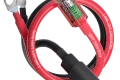
Another mistake is neglecting cable sizing based on the calculated amperage. If your calculation shows you need 150 amps, you cannot use standard household wiring. You must use heavy-gauge battery cables (such as 2/0 AWG) to handle the high current without creating a fire hazard. Using thin wires with high amperage leads to voltage drop, which forces the inverter to work even harder, creating a vicious cycle of inefficiency.
Risks of Incorrect Sizing
If you undersize your inverter, the most common result is the unit shutting down during peak demand. However, the more dangerous scenario involves overheating. An inverter pushed to its limit for extended periods will degrade its internal components, specifically the capacitors. This leads to early failure or, in extreme cases, melting of the internal terminal blocks. Conversely, extreme oversizing is not necessarily dangerous, but it is inefficient because large inverters have a higher “idle consumption” rate, meaning they drain your battery even when you aren’t powering anything.
Practical Tips for Long-Term Reliability
Always aim for an inverter that operates comfortably at 50 to 75 percent of its maximum rated capacity. This “sweet spot” ensures the unit runs cooler and lasts significantly longer. Additionally, keep your inverter in a well-ventilated area away from direct sunlight or moisture. Inverters rely on internal fans to dissipate the heat generated by the conversion process; blocking these vents will cause the unit to throttle its power output, effectively reducing its capacity during hot days.
Q: Does the inverter size itself matter for the battery?
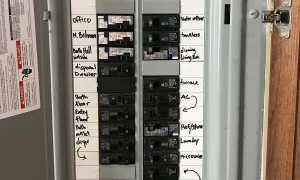
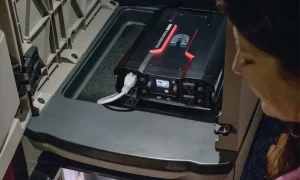
📷 Photo by lowes.com
A: Yes, the inverter size determines the maximum potential draw from your batteries. If your inverter is too large for your battery bank’s discharge capability, you could damage your batteries by pulling too much current too quickly.
Q: Can I use a 2000W inverter for a 200W load?
A: You can, but it is not ideal. Large inverters consume more power just to stay on (idle draw). For a 200W load, a smaller, more efficient inverter will result in longer battery life.
Q: What happens if I ignore the efficiency factor?
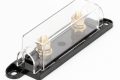
A: You will underestimate the current draw. This leads to incorrect wire sizing and potentially installing fuses that are too small, causing your system to blow fuses or trip breakers unexpectedly during normal operation.
By following these calculations and considering the efficiency and safety margins, you can build a power system that is not only functional but also safe and durable. Always prioritize high-quality cables and proper ventilation to ensure your inverter performs exactly as expected under load.
📷 Photo by lowes.com